For decades, small businesses relied on traditional landlines and bulky PBX systems to manage customer communication. Those systems now struggle to meet modern customer expectations.
Every missed call can become a lost lead.
Every missed call = a missed lead. In 2026, missed calls often mean lost revenue and customers choosing competitors with faster response systems.
Today, 52% of customers expect a response within an hour, and if they hit a busy signal or a generic voicemail, they’re gone.
The challenge?
Small businesses are overwhelmed with choices of VoIP tools, IVR systems, AI call agents, and cloud contact centers. Determining what truly works is challenging.
Automated phone systems help solve this problem.
This guide highlights the top 10 automated phone systems for small businesses, helping you strike the ideal balance between sophisticated automation and human interaction.
How Automated Phone Systems Work
An automated phone system is a cloud-based solution that manages business calls without requiring staff to handle every interaction manually.
What Happens During a Call
When someone calls your business:
- They hear a greeting
- They’re guided through options (press 1, press 2, etc.)
- The system routes them to the right place
Core Features
- Auto-attendant → answers calls instantly
- IVR (Interactive Voice Response) → guides callers
- Call routing → sends calls to the right team
- Voicemail → captures missed calls
- Call analytics → tracks performance
Benefits of Automated Phone Systems for Small Businesses
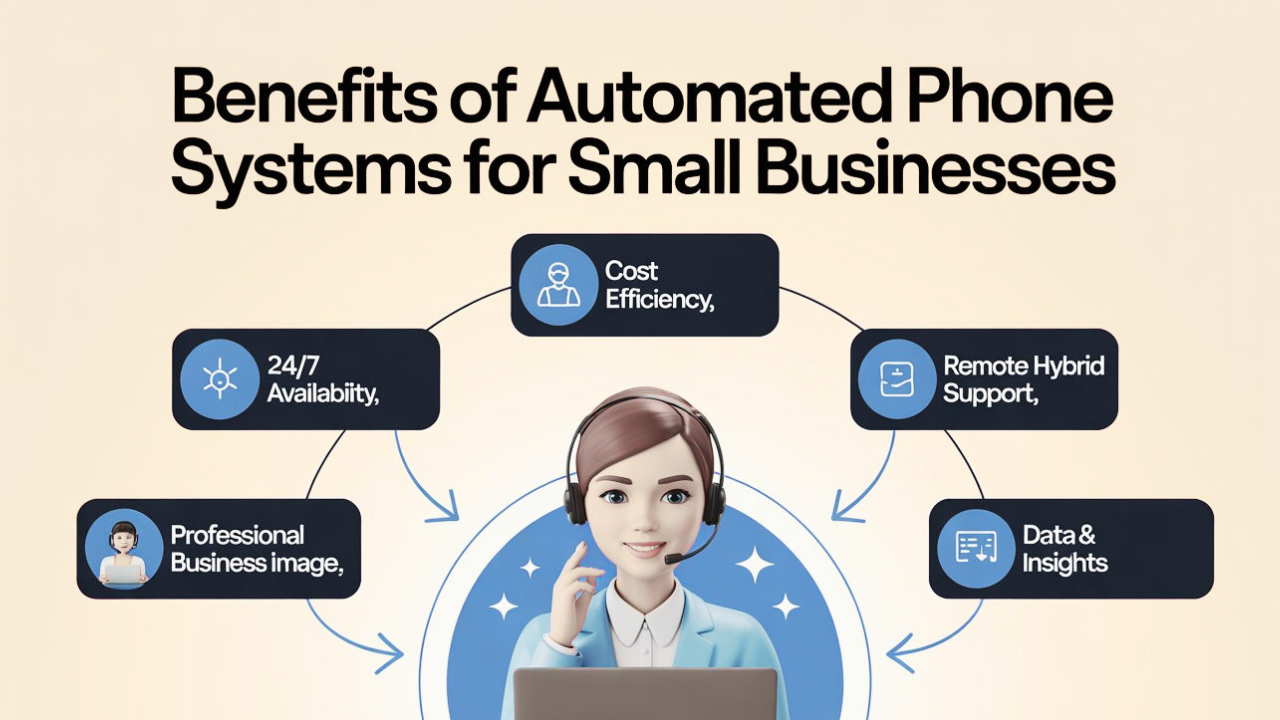
Several key benefits make automated phone systems valuable for small businesses.
1. 24/7 Availability
An AI receptionist can answer calls and capture leads outside standard business hours.
An automated phone system helps reduce missed calls and unnecessary voicemail drop-offs.You capture leads around the clock without paying for overnight staff.
2. Cost Efficiency
Most automated phone systems cost between $100 and $1,200 per year. In comparison, full-time receptionist salaries and benefits often range from $30,000 to $40,000 annually.
This results in a cost reduction of more than 90% while helping improve availability and consistency.
3. Professional Business Image
A polished auto-attendant, professional hold music, and intelligent call routing signals to every caller that you run a real, established operation, even if you're a one-person shop working from home.
4. Support for Remote and Hybrid Teams
Cloud-based systems route calls to your team wherever they are, whether on a laptop, mobile app, or desk phone. Your customers get one consistent number; your team gets total flexibility.
5. Data Accuracy and Insights
In addition to managing continuous calls, contemporary automated phone systems also assist with recording, transcribing, sentiment analysis, monitoring resolution rates, and directly syncing data to your CRM.
You cease speculating and begin basing choices on what your clients are genuinely saying.
7 Best Automated Phone System Options for Small Businesses
1. Callsi
Summary

Callsi AI is a next-generation automated phone system designed to handle the entire call lifecycle from answering calls to qualifying leads and syncing data into your CRM without human involvement.
It functions like a 24/7 AI receptionist and sales rep combined, ensuring no opportunity slips through the cracks.
What Makes It Different:
It focuses heavily on AI call handling and instant response, reducing missed opportunities.
Key Features:
👉 Instant AI call answering (no missed calls)
👉 Automated lead qualification (custom question flows)
👉 CRM sync (all data captured automatically)
👉 Inbound + outbound calling
👉 Natural human-like voice AI
Ideal For:
Small businesses that want hands-off call management
2. RingCentral
Summary

One of the most well-known brands in business communications, RingCentral offers a single platform that integrates team messaging, video conferencing, calls, and now an AI receptionist that scans your website to deliver precise, intelligent responses.
It's built for businesses that want a single system to replace multiple communication tools.
What Makes It Different
Its AI receptionist can pull information directly from your website to answer customer questions, going beyond basic call routing to provide real, accurate responses without manual scripting.
Key Features
👉 AI receptionist with website-based answers
👉 HD voice, video conferencing, and team chat
👉 Advanced IVR and call routing
👉 Call recording and real-time analytics
Ideal For
Growing teams needing an all-in-one platform
Main Focus
Unified communications
3. CloudTalk
Summary

For sales and support teams, CloudTalk is a cloud-based calling platform that combines deep CRM integrations, automation, and artificial intelligence to optimize high-volume communication.
What Makes It Different
Its AI-powered dialer detects voicemail in ~1.5 seconds and connects reps only to live calls, enabling 80+ meaningful conversations per day and eliminating wasted time.
Key Features
👉 AI Voice Agent for 24/7 inbound handling
👉 Parallel dialing for high-volume outbound calls
👉 Conversation intelligence & call analytics
👉 Deep CRM integrations
Ideal For
Sales-driven businesses & International businesses
Main Focus
Performance tracking
4. Nextiva
Summary

In order to provide small businesses with enterprise-level customer experience tools, Nextiva is a unified communication platform that integrates calls, SMS, live chat, and video into one system. Its AI sorts and routes inquiries from all channels, giving small businesses the kind of omnichannel intelligence that used to require a dedicated enterprise platform.
What Makes It Different
Nextiva brings all communication channels into a single AI-powered inbox, so every interaction calls, texts, chats, and email, is connected. Your team gets full context before responding, not just isolated conversations.
Key Features
👉 Quick setup auto-attendant
👉 Toll-free number included
👉 CRM integrations & call recording
👉 Caller ID customization & spam blocking
Ideal For
Customer-focused businesses & Service businesses
Main Focus
Omnichannel customer experience in one platform
5. Dialpad
Summary

Dialpad is a real-time artificial intelligence (AI)-powered cloud communication platform that analyzes conversations in real time to help teams respond more intelligently and quickly.
Additionally, it uses this intelligence to instantly route calls to the best team member and provide agents with real-time response recommendations.
What Makes It Different
Dialpad doesn’t just route calls, it listens and understands them in real time, providing live coaching, sentiment analysis, and smart routing based on what the caller is actually saying.
Key Features
👉 AI-powered auto-attendant
👉 Live sentiment analysis & insights
👉 Custom call flows via APIs (logic, variables)
👉 Multi-channel support (voice, video, messaging)
Ideal For
Teams that rely on conversations and insights
Main Focus
AI-driven communication
6. Aircall
Summary

Aircall is a cloud-based phone solution trusted by so many companies and businesses, built with a clear focus on helping sales and support teams communicate faster and more effectively.
Its back-to-back dialing, one-click call logging, and deep CRM integrations make it a favorite among teams that live on the phone and can't afford friction in their workflow.
What Makes It Different
Its back-to-back dialing and clean interface let teams move through calls quickly with minimal effort, reducing downtime and eliminating manual tasks.
Key Features
👉 Automatic back-to-back dialing
👉 One-click CRM call logging
👉 Real-time call monitoring & coaching
👉 Call queuing & smart routing
Ideal For
Sales and support teams
Main Focus
Fast, frictionless calling for sales and support
7. GoTo Connect
Summary

Calls, video conferences, and messaging can all be done in one location with GoTo Connect, a straightforward all-in-one platform.
It offers a simple setup and seamless experience without requiring technical expertise or an IT staff. If you want modern features without the usual complexity, you’ll find it a solid option.
What Makes It Different
It's an intuitive drag-and-drop dial plan that lets you set up call flows quickly, and no technical knowledge is needed.
Key Features
👉 Visual drag-and-drop dial plan editor
👉 Unlimited calls in the US and Canada
👉 Virtual voicemail and call forwarding
👉 Multi-site support for distributed teams
Ideal For
Remote teams & businesses with multiple locations
Main Focus
Simple, centralized communication without complexity
How to Choose the Right Automated Phone System (The Audit)
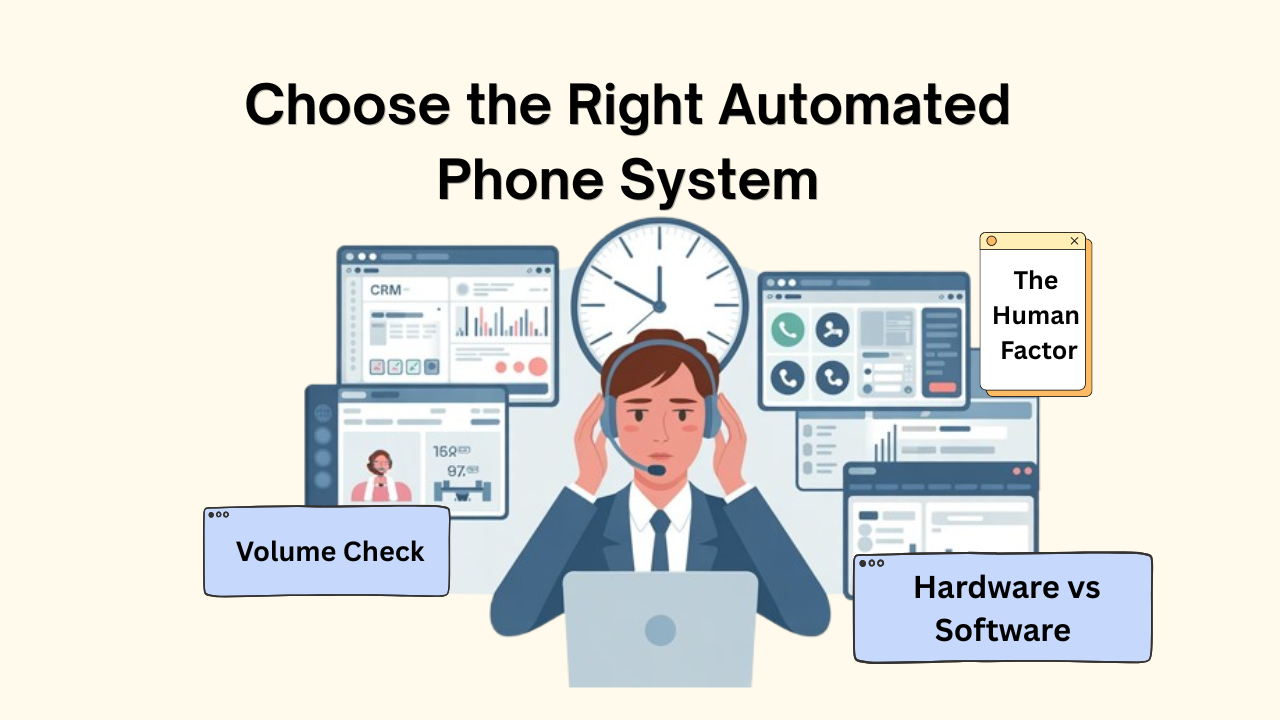
Pick the wrong system, and you’re not just wasting money, you’re losing potential customers.
1. Volume Check
So, first and foremost, ask yourself how many calls you handle.
📍 Low volume → A simple VoIP or basic auto-attendant will do the job
📍 High volume → An AI-powered or call center system is essential
If your calls are growing, look for tools that offer smart routing, call queues, and real-time insights.
2. Hardware vs. Software
Next, think about how your team works.
📍 Desk phones → Best for office-based setups
📍 Mobile or laptop → Better for remote or flexible teams
So, does your team work from a desk or while on the go? Choose a system that fits their daily workflow, not the other way around.
3. The Human Factor
So specify how much automation you want.
📍 Fully AI → Handles calls and qualifies leads, no human needed
📍 Hybrid → AI + human backup for complex conversations
So, match the system to your call volume, team setup, and level of automation, rather than the other way around.
Conclusion
Automated phone systems have become accessible and practical for businesses of all sizes. They’ve become a smart and practical choice for improving how your business handles communication, working 24/7, managing calls smoothly, and fitting into your existing tools.
Businesses can reduce operational costs while improving response times and customer experience. Compared to hiring a full-time receptionist, the investment is much lower, yet the performance is often better.
In simple terms, you spend less but respond faster, and that directly impacts customer satisfaction. If your goal is to capture leads, reply instantly, and never miss a call, tools like Callsi can be a strong option to start with. Start with a free trial, test how it handles your calls, and measure the difference. The faster you respond, the fewer customers you lose.
FAQs About Automated Phone Systems
Q1: How much does an automated phone system cost for a small business?
A: In contrast to a full-time receptionist, who costs between $30,000 and $40,000 per year, AI-first platforms such as Callsi begin at a fixed monthly rate of around $47.
Even a high-end automated system can save you 90% or more.
Q2: Will automated phone systems work for remote and hybrid teams?
A: Yes, and their ability to adapt is one of their biggest strengths. Since these systems are cloud-based, your team can handle calls from anywhere, whether they’re using a mobile phone or a laptop, while keeping business and personal calls separate.
Q3: Is Callsi AI suitable for minimal businesses or solo owners?
A: Definitely. It works especially well for solo operators and small teams. It can manage calls, filter leads, and organize data, so you can focus more on your work instead of handling every call yourself.